A Freeze-Dried Coffee Patent Shows Why Small Extract Doses Need Blend Checks
A Freeze-Dried Coffee Patent Shows Why Small Extract Doses Need Blend Checks
- Example 4 in KR100375370B1 combines 99.81% freeze-dried coffee powder and 0.19% powdered extract.
- At 0.19%, a 100 kg mass-balance illustration allocates 190 g to the extract and 99.81 kg to coffee.
- For applicable Lifeworth powder projects, the package screen runs 21 days at 45 °C and 85% RH to check moisture-related changes.
Use the example to understand the dosing problem
Korean patent KR100375370B1 describes roasting, water extraction, concentration, and freeze-drying before blending the resulting powders. Example 4 uses a coffee-forward split. The example helps calculate weighing and sampling requirements for a small addition and gives the buyer a concrete number to discuss.
Work the numbers before asking for a trial
These figures scale the published ratio by mass. The finished batch size and commercial material specification have to be agreed separately.
| Illustrated blend | Coffee powder | Powdered extract |
|---|---|---|
| 1 kg | 998.1 g | 1.9 g |
| 10 kg | 9.981 kg | 19 g |
| 100 kg | 99.81 kg | 190 g |
Confirm how the minor component reaches every sample
For an applicable powder project, Lifeworth uses a 21-day screen at 45 °C and 85% RH in the intended pack. Agree on acceptance limits before the test and record caking, dispersion, and seal condition alongside any required assay. Use the full stability plan to support shelf life.
Define the minor ingredient’s identity, practical weighing accuracy, blending sequence, and sampling locations. Check whether the chosen assay or marker is measurable at the theoretical level in the finished mix. Evaluate aroma, clumps, and sediment separately from analytical uniformity.
KR100375370B1 and its published examples
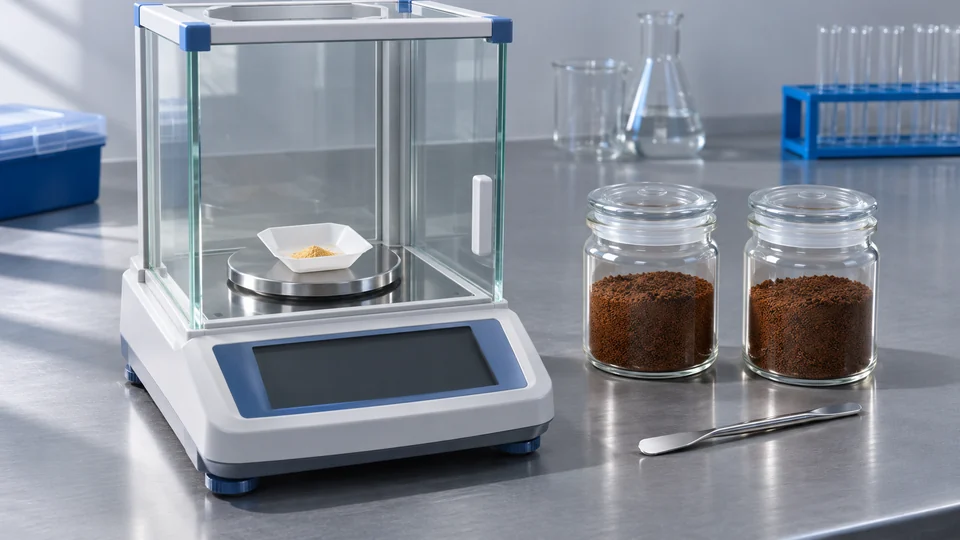
Illustration of a low-dose extract being weighed beside coffee-blend samples. Retain samples from the agreed blend locations for the uniformity check.
Build a brief for the product you intend to launch
Provide identity, source documents, intended dose and market review.
State coffee powder grade, desired sensory profile and preparation method.
Agree on the marker, lot sampling and acceptance limits before the trial.
Decide on moisture barrier, seal test and storage conditions.
Send the coffee specification, extract documents, serving mass and finished pack to discuss feasibility. For eligible projects with approved specifications and available materials, Lifeworth can target 3 days for samples, 25 days for a first order, and 15 days for a repeat order. Confirm dates against the agreed scope.
Frequently asked questions
Is 0.19% the usual proportion for herbal coffee?
The figure comes from Example 4 in the cited patent. Select a dose from the actual extract, intended use, sensory target, and market assessment.
What does 0.19% mean in a 10 kg calculation?
Multiply 10 kg by 0.0019 to get 0.019 kg, or 19 g of powdered extract.
What is the main manufacturing risk at that dose?
Check weighing loss and uneven distribution. Define how the method can detect the marker where its concentration is low.
Can the patent alone support shelf life or label claims?
Assess the product’s own pack, stability, ingredient status and proposed wording with the applicable evidence.